
Overview
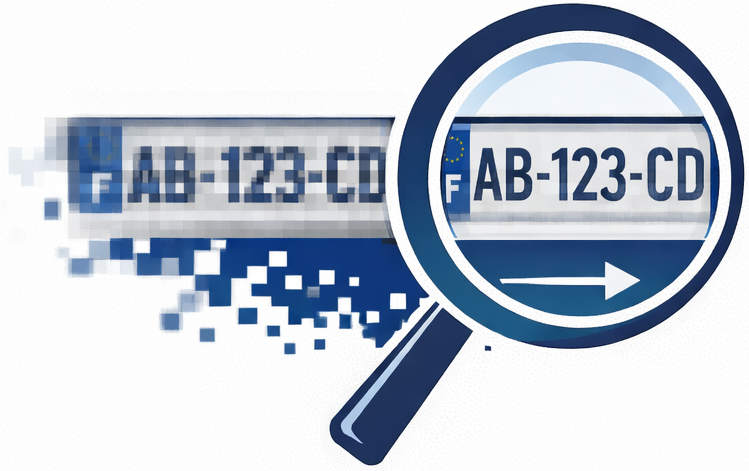
The Extreme In-The-Wild License Plate Super-Resolution (XLPSR) Challenge establishes a benchmark for reconstructing readable French license plates from low-resolution, degraded video frames. Participants must develop super-resolution models that address authentic degradations like motion blur, compression artifacts, and noise, specific to real-world acquisition scenarios.
The core requirement is the accurate, hallucination-free recovery of the alphanumeric characters and the standardized format of French plates, ensuring outputs are reliable for downstream Optical Character Recognition (OCR). Solutions may process frames independently or exploit temporal coherence in video. The use of auxiliary modules for denoising, deblurring, or dehazing is permitted within the model pipeline.
Significance
Pushing SR into extreme regimes: Unlike common SR challenges (NTIRE, AIM), XLPSR addresses magnification under severe real-world degradations, motivating attention, diffusion-based SR, and degradation-aware pipelines.
High-impact application: Readable plates are critical for ITS, security, and forensics. The primary automated metric prioritizes functional correctness over purely perceptual quality.
Hallucination-free generation: OCR-based evaluation encourages fidelity and avoids plausible but incorrect characters, aligning with reliability in generative models.
🏆 Final Results
The XLPSR Challenge is now complete!
We thank all participating teams for their outstanding contributions. The final rankings and winners will be announced during the Grand Challenge Special Session at IEEE ICIP 2026 in Tampere, Finland.
📅 When: 13–17 September 2026
📍 Where: Tampere, Finland
🎯 Session: Grand Challenge Special Session